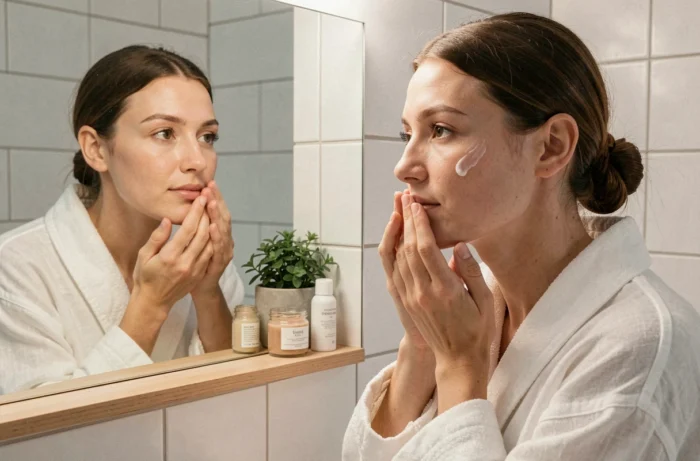
A bottle of vegetable oil forgotten at the back of a cupboard, a cream bought for its “green” packaging but never finished: we accumulate more than we care for ourselves. Natural self-care starts with a clear-out, not a purchase. Cutting down on products, understanding what you apply to your skin and adapting your routine to what it actually needs: that’s the foundation of authentic beauty that lasts.
Natural beauty routine: fewer products, better results
We tend to pile on the steps—serum, essence, mist, mask—because tutorials present them as a mandatory sequence. In practice, skin exposed to too many active ingredients at once can start to react: redness, excess shine, tightness after rinsing.
Three steps are enough morning and evening for most skin types: cleanse, moisturize and protect from the sun in the morning. In the evening, replace sunscreen with a targeted treatment if your skin needs one; otherwise, stick to the cleanser-and-moisturizer duo.
Resources such as beauteauthentique.fr provide details on these short routines tailored to different skin types, helping you avoid unnecessary purchases.
Simplifying your routine also makes it easier to spot what works and what causes irritation. With six products on your face, identifying the cause of a breakout can be a real puzzle. With two or three, the culprit becomes clear within a few days.
Reading a natural cosmetics label: allergens and claims
The word “natural” printed on a tube has no single regulatory definition. Cosmetic claims in Europe must meet standards for truthfulness, evidence and clarity, but no authority awards an official “natural” label. Claims about the percentage of ingredients of natural origin must be clear and substantiated, which is not always the case.
Fragrance allergens: what changes in 2026
European regulations have expanded the list of fragrance allergens that must be declared on packaging. Since August 1, 2026, newly marketed products must comply with these new labeling rules. Products already on the market may be sold through until July 31, 2028.
In practical terms, this means that substances previously hidden under the term “parfum” are now listed by name in the INCI ingredient list. For anyone looking to avoid a specific ingredient (linalool or citronellol, for example), this is a clear improvement: read, check and decide.
- Check the INCI list rather than the marketing claims on the front of the packaging: it is the only standardized information.
- Look for “fragrance-free” claims, which indicate that no fragrance substances have been deliberately added.
- Compare similar products by counting the allergens listed: the one declaring fewer allergens is not necessarily better; it may simply contain less fragrance.
Natural facial skincare: choose for your skin, not the trend
Jojoba oil works well for combination skin because its lipid composition is similar to that of human sebum. Applied to very dry, dehydrated skin, it won’t be enough to retain water in the epidermis. Oil nourishes; it doesn’t hydrate—confusing the two is still the most common mistake in natural skincare.
To hydrate, look for a product containing humectants (vegetable glycerin, aloe vera, biotechnologically derived hyaluronic acid). To nourish, turn to oils and butters (shea butter, argan oil, sweet almond oil). Skin that feels tight after a shower needs both, in this order: humectant first, then oil or butter to seal in moisture.
Adjust your routine with the seasons
In winter, cold weather and indoor heating dry out the air. Skin loses more water through evaporation, making a richer balm at night a good choice. In summer, heat stimulates sebum production: switching to a lighter day cream helps avoid overloading the skin without skipping hydration altogether.
These seasonal changes vary from person to person: oily skin in a polluted urban environment won’t react the same way as dry skin in a mountain climate. Observe, adjust and avoid changing your entire routine all at once.

Daily habits and lifestyle: what skincare can’t replace
No serum can make up for too little sleep or neglecting to stay hydrated. Your skin reflects what’s happening inside: digestion, stress, fatigue and diet. Drinking water regularly, getting enough sleep and limiting sources of dietary inflammation (refined sugars, alcohol) can visibly improve your complexion within a few weeks.
Facial massage stimulates microcirculation without any products. A few minutes of gentle pressure along the jawline, around the eyes and across the forehead is enough to reduce puffiness in the morning. You can use a stone gua sha or simply your clean fingers.
- Clean your tools (brushes, sponges, gua sha) at least once a week to prevent bacterial growth.
- Change your pillowcase every three to four days: fabric collects sebum, sweat and haircare residue.
- Protect your skin from the sun even on cloudy days, using a mineral sunscreen if you prefer filters of natural origin.
Natural self-care means accepting that your skin doesn’t need ten steps to stay healthy. A cleanser suited to your skin, a moisturizer chosen for your skin type and a few good hygiene habits cover most needs. The rest is about enjoyment, not necessity.