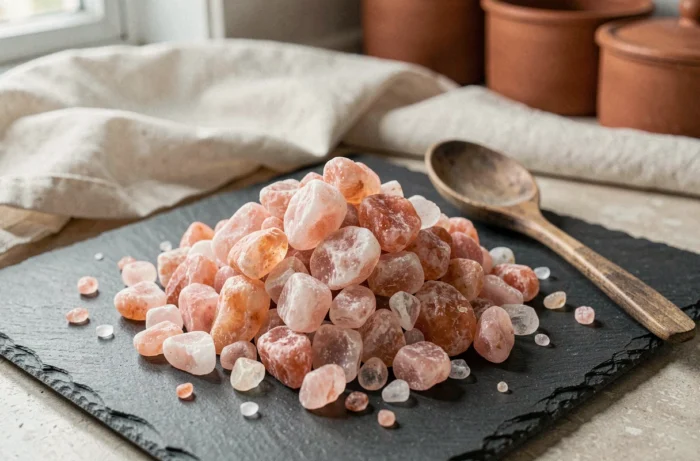
Himalayan pink salt is made up of more than 98% sodium chloride, just like white table salt. The trace minerals that give it its color (iron oxides, calcium, magnesium, potassium) are nutritionally negligible. Calling it “mineral-rich salt” is a marketing shortcut, not a biochemical fact.
Analytical profile of pink salt: trace minerals and variable contaminants
Of the 84 minerals often cited by retailers, almost all are present at parts-per-million levels. At a reasonable daily intake, they make no meaningful contribution to recommended daily allowances. The calcium, magnesium, and potassium in pink salt do not even meet a fraction of one percent of an adult’s needs.
Contaminants are the issue that deserves more attention. A 2020 analysis published in the journal Foods, which examined 31 samples of pink salt, found that one batch from Peru had a lead content exceeding the Australian reference limit.
This finding does not apply to every batch or source. We recommend choosing a supplier that can provide independent batch testing and clearly identify the salt’s origin (in most cases, the Khewra mine in Pakistan).
For more information about potential health risks, Himalayan pink salt on Ma Santé 360 explains regulatory limits and precautions to take.

Pink salt and iodine: an underestimated risk of deficiency
Conventional table salt sold in France is iodized through industrial fortification. This provides a significant share of daily iodine needs, particularly for at-risk groups such as pregnant women and children. Pink salt is not iodized, unless the packaging explicitly says otherwise.
Completely replacing table salt with pink salt without regularly getting iodine from other sources (seafood, seaweed, dairy products) can lead to a gradual deficiency. This is not just a theoretical concern: it applies to anyone whose diet is already low in iodine and who makes this switch out of habit.
Check your iodine intake before switching salts
Before giving up iodized salt, take stock of your dietary sources of iodine. If you only occasionally eat fish, shellfish, or seaweed, the basic recommendation is to continue using iodized salt daily. Pink salt can then be used as a finishing salt or for occasional seasoning, but not as your main salt.
- Fish and seafood: reliable sources of iodine; eat them several times a week to meet your needs
- Dairy products: contribute to iodine intake, although levels vary depending on production methods
- Seaweed (nori, wakame, kombu): very high in iodine; use with care to avoid excessive intake
- Iodized table salt: the simplest and most consistent source for most people
Clinical data on pink salt and blood pressure: what the only available trial shows
A Brazilian crossover trial published in 2022, involving 17 women with hypertension, directly compared Himalayan pink salt with conventional table salt. The result: no difference in blood pressure or urinary sodium between the two consumption periods. The sample was too small to draw a definitive conclusion, but the findings do not support any cardiovascular benefit specific to pink salt.
To date, this is the only published comparative clinical evidence. Marketing for pink salt often suggests that it is better for cardiovascular health, sometimes citing its “crystalline structure” or “energetic vibration.” No physiological mechanism supports these claims.
Sodium remains the key factor, whatever the salt
The WHO recommends that adults consume no more than 5 g of salt per day. This limit applies to all salts, whether pink, grey, black, or white. The color of the crystals does not change sodium’s effect on blood pressure or fluid retention.
Pink salt prices and supply chains: what consumers are really paying for
Pink salt is extracted mainly from the Khewra mine in Pakistan, about 300 km from the Himalayan range. “Himalayan salt” is a commercial name, not a protected geographical indication. The purchase price in Pakistan is very low, while retail prices in Europe are commonly ten to twenty times higher.
This markup covers transport and packaging, but above all, premium positioning. In terms of composition, there is no justification for such a large price difference compared with unrefined sea salt or Guérande salt, which have comparable trace mineral profiles.
- Khewra pink salt: minimal extraction costs, unregulated name, high distribution margins
- Guérande salt (France): artisanally harvested, geographically traceable, with a similar trace mineral profile
- Unrefined sea salt: an affordable alternative, often naturally iodized depending on its origin, with no marketing markup
Pink salt offers no measurable benefit over ordinary quality salt. Its appeal lies in its texture and color as a culinary finishing salt, not in any nutritional advantage. Using iodized salt as your main salt and saving pink salt for occasional use is the most sensible approach for both health and cost.