
When a Moroccan website takes more than four seconds to load, most visitors leave the page. Choosing web hosting in Morocco is no longer just about renting disk space: it affects legal compliance, perceived speed for users, and the ability to handle traffic spikes. This year, several regulatory and technical developments are reshaping the local market.
Cloud decree and DGSSI qualification: what’s changing for sensitive data in Morocco
Decree No. 2-24-921 governs the use of cloud services by public entities and critical infrastructure operators. A hosting provider that stores sensitive data for a Moroccan government agency must obtain a qualification issued by the DGSSI. Requirements cover the physical location of servers, access management, and contract reversibility.
Why should you pay attention to this, even if you run a private website? Because many providers share their infrastructure. A hosting provider that invests in meeting the requirements for this qualification also strengthens the security of its standard commercial offerings. It’s a sign of reliability worth checking before you sign up.
Another often-overlooked point: off-site backups trigger a data transfer. Even if your primary server is in Casablanca, a daily backup sent to a European data center is subject to the transfer conditions set out in Law 09-08. In 2025, the CNDP published a dedicated form for these transfers. A hosting provider that is transparent about this will help you avoid compliance risks.
Following InExt Com’s latest news on web hosting in Morocco helps you stay up to date with these regulatory developments throughout the year.

Cloud region in Casablanca: local hosting with world-class services
The arrival of a public cloud region in Casablanca is a game changer for Moroccan businesses. Until now, using a hyperscaler’s managed services (databases, artificial intelligence, containers) meant relying on data centers in Europe. Network latency added a few dozen milliseconds to every request.
With a local region, an e-commerce website hosted in Morocco can use advanced cloud services while keeping its data in the country. Moroccan visitors will notice the speed improvement.
Proximity does not automatically mean compliance
Beware of a common misconception: hosting in Morocco does not guarantee regulatory compliance. DGSSI qualification, the requirements of Law 09-08 on personal data, and contractual reversibility obligations must all be checked independently of the server’s physical location. A Casablanca data center operated by an unqualified provider will not meet the requirements for a sensitive project.
Sovereign data centers and infrastructure projects in Morocco
Several major projects have been announced this year to equip Morocco with sovereign hosting capacity. These investments are intended to meet growing demand related to artificial intelligence and large-scale data processing.
These investments reflect a clear ambition: to make Morocco a regional digital hub. For local businesses, this means more choice and, over time, competitive pressure on hosting service prices.
Assessing a data center beyond its megawatt capacity
Announced power capacity is not a measure of service quality. A data center may boast impressive capacity while falling short on network redundancy, cooling, or security certifications. Before choosing a hosting provider that relies on new infrastructure, check these practical criteria:
- Power and network redundancy (dual power supplies and connections to multiple telecom operators) protect against outages
- ISO 27001 and ISO 9001 certifications attest to formalized security and quality management procedures
- Contractual reversibility ensures you can retrieve your data and migrate without technical barriers
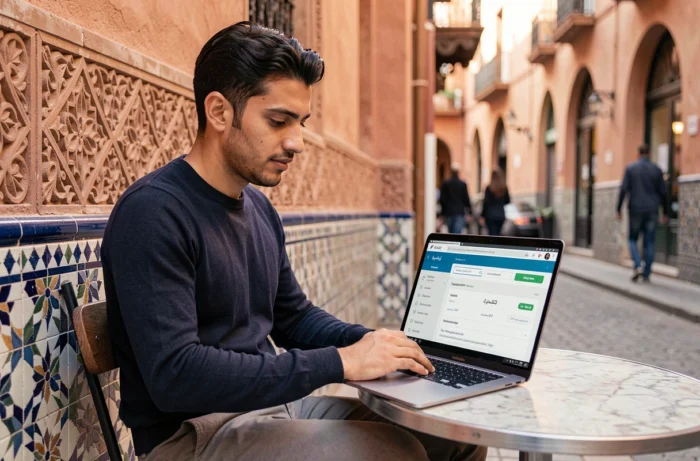
How to choose a Moroccan web hosting provider in 2026
The monthly price is still the most visible factor in comparison charts, but it can hide more significant differences over time.
A local hosting provider offers two practical advantages: faster response times for visitors in Morocco and technical support in the same time zone, often in French and Arabic. Both can make a difference when an issue arises at 6 p.m. on a Friday.
Here are the points to consider before choosing a provider:
- The type of SSL certificate included in the plan (a basic free certificate may be enough for a blog, but an online store needs an extended validation certificate)
- How often automatic backups are made and where they are stored, checking whether this involves transferring data outside Morocco
- Technology compatibility with your CMS or framework (PHP versions, databases, SSH access)
- The ability to scale during traffic spikes without unexpected charges
A hosting provider that is transparent about its legal obligations to the CNDP and DGSSI deserves special consideration. This transparency signals technical and legal maturity.
Morocco’s web hosting market is taking shape rapidly this year, driven by new infrastructure, a more clearly defined regulatory framework, and the arrival of nearby cloud services. Choosing a local provider is no longer just about the advertised price. Compliance with DGSSI requirements, the actual location of backups, and the documented quality of the data center are now what distinguish a reliable service from one that is simply cheap.