A yoga mat tucked into a corner of the living room, two dumbbells stored under the sofa and a resistance band hooked over the door handle: we’ve all started out like this. The problem comes when home workout equipment piles up without any real plan, half of it goes unused after three weeks, and the other half doesn’t suit the exercises we actually want to do.
Choosing the right strength or cardio equipment for home workouts starts with taking stock of your actual space and daily constraints—not copying a shopping list from an online store.
Floors, ceilings and neighbors: the constraints your equipment needs to meet
Before comparing dumbbells or exercise bikes, measure the room. Here’s a simple test: unroll a mat in the middle of your workout area, lie down with your arms stretched overhead, and check that you don’t touch a wall or piece of furniture. If you do, any bulky equipment, such as a rowing machine or adjustable weight bench, will be a constant problem.
Ceiling height matters too. Overhead presses with a barbell or dumbbells require enough clearance. In an apartment, you also need to consider noise and vibration: jumping rope or using a motorized treadmill creates repeated impacts that the neighbor downstairs will feel directly.
Your flooring determines what kind of training you can do. A floating wood floor can’t handle the same loads as a concrete slab covered with tile. EVA foam tiles protect the floor and reduce noise, but they won’t turn a fragile floor into a deadlift platform.
You can browse Mon Coach A Domicile’s sports equipment to find options suited to indoor use, including designs made for smaller spaces.
Home strength training equipment: three purchases to work your whole body
Other guides pile on lists of ten or fifteen accessories. In practice, three well-chosen types of equipment are enough to work your whole body without turning the living room into a gym.
Adjustable dumbbells instead of a full set
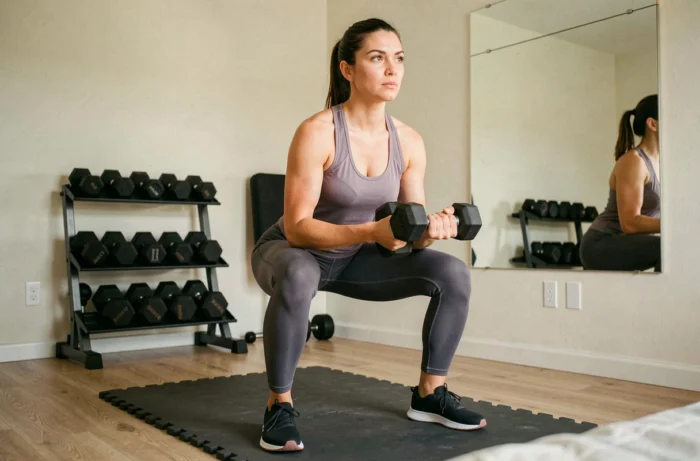
A traditional set of fixed-weight dumbbells, ranging from two to twenty kilos, takes up a lot of space and costs a lot. Adjustable dumbbells replace a dozen pairs with a single piece of equipment. You can change the weight for each exercise, making it possible to progress for months—or even years—without buying more equipment.
The main thing to consider isn’t the maximum weight, but the size of each increment. A system that increases in two-kilo steps works for most upper-body exercises. For leg exercises, add heavy-resistance bands.
Resistance bands: maximum versatility with minimal storage space
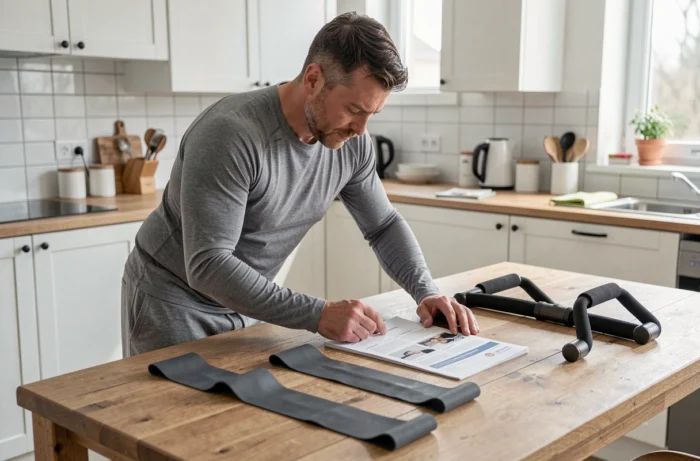
A variable-resistance band fits in a pocket, attaches to a door and can be used for dozens of strength exercises. Beginners can use it on its own, while more experienced users can pair it with dumbbells to add tension at the end of a movement.
- A light band for warm-ups, shoulder rotations and joint mobility work
- A medium band for rows, curls and triceps extensions
- A heavy band for squats, good mornings and assisted pull-ups
Flat or adjustable bench: one piece of furniture that makes all the difference
Without a bench, you have to do bench presses and rows on the floor, which limits your range of motion. An adjustable bench gives you access to around thirty additional upper-body exercises. If space is limited, choose a foldable model and check that the folding mechanism doesn’t wobble from side to side.
Home cardio equipment: choose a machine that suits how you actually work out
A common mistake is buying a treadmill because it seems versatile, only to see it become a clothes rack three months later. The most effective cardio machine is the one you use regularly, not the one with the most programs.
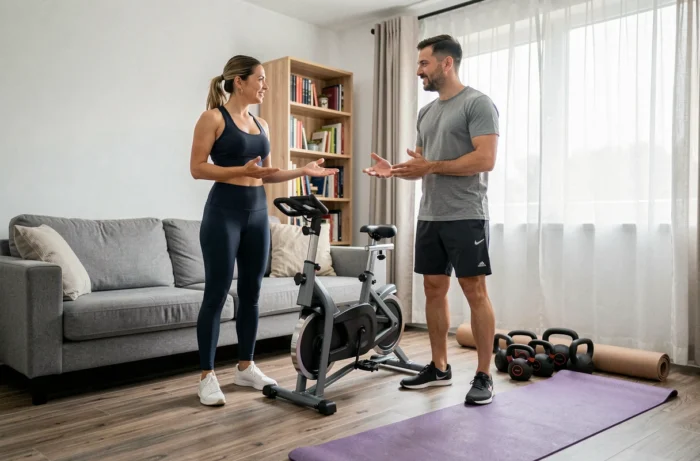
An exercise bike—upright or spin—is still the quietest and most compact option. It’s a good choice for anyone who wants to protect their joints while building endurance. A spin bike with magnetic resistance makes almost no noise, so it’s suitable for apartment use, even late at night.
A rowing machine works both the upper and lower body, making it a great all-round option for anyone looking to combine cardio and strength training in a single workout. The drawback: you’ll need about two meters of floor space while using it. Some models can be stored upright, but you’ll need a free wall and a secure wall mount.
An elliptical trainer is a good compromise for people returning to exercise or dealing with joint pain. Its low-impact movement protects the knees and ankles while still providing an effective endurance workout. For intermediate and advanced users, the downside is that it can be difficult to increase the intensity significantly over time.
Repairability and lifespan: overlooked factors when buying home workout equipment
Fitness equipment bought online can become unusable as soon as a wear part fails if the manufacturer doesn’t offer spare parts or after-sales service in France. France’s repair bonus also covers sports and leisure goods, meaning there’s a network of certified repairers who can work on certain types of equipment.
Check that spare parts are available before you buy to avoid throwing away a working machine because of a worn cable or bearing. On an exercise bike or rowing machine, the parts that tend to wear out first are the drive belt, brake pads and seat.
- Check the manufacturer’s website for a spare-parts catalog
- Choose brands that offer more than two years’ warranty on the frame
- If buying second-hand, inspect the cables, welds and adjustment mechanisms before paying
Without the original receipt, it can be harder to make a claim if a second-hand item turns out to be faulty. Well-inspected second-hand equipment can last just as long as new equipment, provided you know how it was used and check the metal parts for corrosion.
Choosing home workout equipment ultimately comes down to making three decisions in the right order: measure your available space, identify two or three types of exercise you’ll actually do each week, then buy the equipment you need and check that it can be repaired. You can add the rest later, when you really need it.