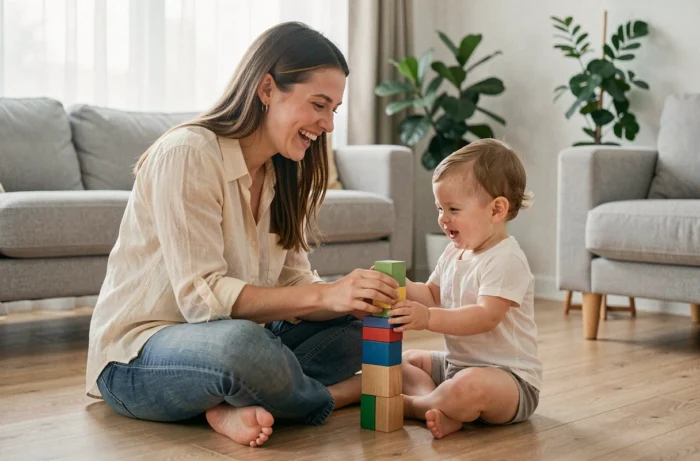
A child stacking blocks, watching an ant on the sidewalk or repeating a new word ten times in a row is hard at work. Early development can’t be scheduled like a private lesson. It grows through everyday moments, as long as the adult is truly present to share them.
Parental technoference: when a parent’s phone gets in the way of a child’s development
Have you noticed that your child tries harder to get your attention when you’re looking at your phone? There’s a name for this phenomenon. Santé publique France uses the term parental technoference to describe the interruptions smartphone use causes in interactions between parents and children.
The issue isn’t the child’s screen, but the parent’s. A conversation interrupted by a notification breaks the flow of an emerging verbal exchange. For a toddler learning to speak, every sentence left unfinished is a missed opportunity.
In practice, this leads to repeated micro-interruptions. A parent is reading a story, their phone vibrates, they glance at it, and the child loses eye contact. This kind of scenario can happen dozens of times a day. Over the weeks, these interruptions reduce the quantity and quality of verbal interactions.
The first practical step is simple: leave your phone in another room during playtime and meals. This isn’t self-help advice; it’s a practical condition that allows a child’s development to unfold as it should. Among Concept Enfance’s advice for parents is the idea of refocusing attention on the everyday moments you share.

Screen-free activities for children under three that need no special equipment
There’s no need to buy a Montessori kit for every stage. Language remains the first tool for supporting a child’s development. Naming what your child touches, describing what they see and rephrasing their attempts at new words: these everyday actions build vocabulary and confidence.
Before their first birthday, face-to-face games (smiling, making faces, copying expressions) help children recognize emotions. Between one and two, filling and pouring games (pouring water, transferring rice) develop fine motor skills. After age two, pretend play (pretending to cook or care for a stuffed animal) opens the door to storytelling.
Here are a few free activities that fit easily into everyday life:
- Talk about what you see on a walk, describing the colors, sounds and textures along the way to enrich your child’s sensory vocabulary.
- Offer a box of household objects (wooden spoons, cups, pieces of fabric) and let your child explore freely, without specific instructions.
- Read a short story together every evening and ask simple questions about the pictures, even if your child can only respond with gestures.
- Sing nursery rhymes with accompanying actions to connect musical rhythm with motor coordination.
What these activities have in common is that they require an attentive adult. A sensory box placed in front of a child who’s alone loses half its appeal. It’s the conversation around the activity that makes the difference.
Building a child’s confidence and independence through everyday routines
A child’s well-being doesn’t come from stimulation alone. Children who feel secure in a stable environment are more likely to explore. Independence develops when children can anticipate what will happen during their day.
Routines (meals at set times, a bedtime routine, a regular time for play) aren’t restrictive. They provide a sense of security. A child who knows that bath time comes before their bedtime story doesn’t have to spend energy coping with uncertainty. They can put that energy into play.
Supporting emotions without dismissing them
When a child cries in frustration because they can’t put on their shoe, it’s tempting to do it for them. Naming the emotion before offering help changes the dynamic. Saying, “You’re angry because the shoe won’t go on,” gives a name to a feeling that’s still hard to understand.
This process is called emotional co-regulation. Children don’t learn to manage their emotions on their own. They first learn to understand them through an adult’s response. It takes months, sometimes years, and calls for consistency rather than perfection.

Play spaces and local resources for families
Supporting a child’s development isn’t just the parents’ responsibility at home. Santé publique France emphasizes that preventing excessive screen use also requires collective action and practical alternatives to digital devices.
Toy libraries, parent-child centers (LAEP) and public libraries offer supervised spaces for free play. These places give children the chance to play without screens and parents the opportunity to meet other families.
A Terra Nova report recommends expanding these play spaces for young children, including by opening school playgrounds on Saturdays. These proposals are still under consideration and have not yet been widely implemented. Their value lies in a simple but important idea: children’s development is nurtured by social connections and suitable spaces, not just by activities at home.
- LAEP welcome children accompanied by a parent, with no registration or requirement to attend regularly, making them accessible even to families with busy schedules.
- Toy libraries offer a range of play equipment that families may not be able to afford or have room for at home.
- Public libraries organize shared reading sessions for toddlers, with activities suited to each age group.
Finding these resources in your town or neighborhood is a practical step. Children who regularly visit a shared play space develop social skills alongside their sensory and motor abilities.
A child’s well-being depends less on the number of toys they have than on the quality of the time you spend together. A parent who puts down their phone, names emotions and knows where to find local resources already has the most useful tools at hand.