
The CN22 form is the simplified customs declaration required by the Universal Postal Union for any postal shipment to a country outside the European Union or to France’s overseas departments and regions (DROM). If completed incorrectly, it can lead to a customs hold, storage fees or the shipment being returned outright. Filling out this document correctly requires an understanding of a few technical details that most guides gloss over.
Matching the paper CN22 to the electronic data sent to customs
The information on the CN22 attached to the parcel is not the only data provided. When the label is generated using an online shipping tool or postal information system, the data is also sent electronically to customs in the destination country. Any discrepancy between the physical document and the digital declaration triggers an inspection.
This has a direct consequence: if you manually correct information on the printed form without updating the digital entry, the parcel will be flagged. Always make changes at the source, in the label creation tool, and then reprint the document.
To generate a CN22 form to print through La Poste, completing it online is still the most reliable method, as it ensures consistency between the paper form and the electronic data sent to customs authorities.
Filling out the CN22 form: critical fields and common mistakes
The CN22 is a small green label. Every field matters, and there is little room for error.
Contents description and tariff code
The description field must state exactly what the items are, not use a vague category. “Women’s cotton T-shirt” will clear customs. “Clothing” or “gift” may trigger an inspection.
Providing the tariff code (HS code) is optional on the CN22, but including it speeds up customs clearance. The six-digit HS code is universal; the additional four digits vary by country. If in doubt, the first six digits are enough.
Declared value and currency
The declared value must match the actual value of the goods, even for a free shipment (a gift). For a donation, state the estimated market value, not zero. The currency is mandatory: EUR, USD, GBP. Undervaluing the goods can result in a customs fine and seizure of the parcel.
Shipment category
The form offers several boxes to tick: gift, documents, commercial sample, returned goods, sale. Selecting the wrong category changes the tax treatment applied by customs in the destination country. Marking a sale as a “gift” is a false declaration.
- Gift: a shipment between individuals with no payment in return, subject to duty-free thresholds that vary by destination country.
- Sale of goods: triggers the calculation of customs duties and import VAT from the first euro in some countries.
- Commercial sample: for promotional shipments with no resale value, often exempt subject to weight and value limits.
- Returned goods: requires the reference number of the original shipment to justify reimportation duty-free.
CN22 or CN23: the threshold and DROM shipments
The CN22 covers postal shipments whose value does not exceed a certain threshold. Above that, the more detailed CN23 form is required. CN22 and CN23 postal forms cannot be used for shipments valued at more than 1,000 euros: from that amount onward, La Poste prepares and files a formal customs declaration using the Single Administrative Document (SAD).
Shipments to the DROM (Guadeloupe, Martinique, French Guiana, Réunion, Mayotte) are subject to the same customs formalities as international shipments, even though the recipient is in French territory. We find that this is still the most common source of mistakes among occasional shippers.
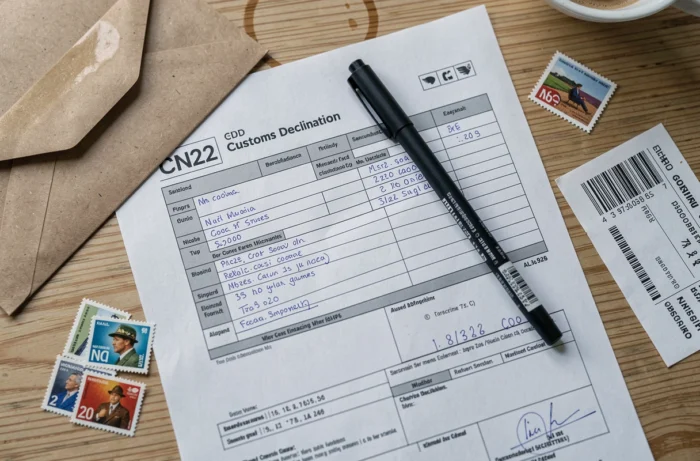
Printing and attaching the CN22 to the parcel
The CN22 comes as a green self-adhesive label or as a printed document to place in a clear pouch attached to the parcel. The standard format is compact, roughly the size of a postcard.
The form must be visible and accessible on the outside of the parcel, never placed inside. A CN22 tucked inside the packaging will be treated by customs as missing.
When printing at home, make sure the document is legible: black ink on a light background, with no corrections or crossed-out text. Postal services reject handwritten forms that are illegible or partly erased. Standard print quality is sufficient, provided all characters are clear.
Keep a copy of the CN22 as proof of export
For distance sales outside the EU, the customs declaration can serve as proof of export for tax purposes. Keeping a copy of the CN22 and the postal receipt provides proof that the goods left the country in the event of a tax audit.
This precaution also applies to non-commercial shipments of significant value. If there is a dispute with the recipient or the parcel is lost, the copy of the declaration is the only document describing the contents of the shipment.
- Keep the CN22 in both digital (PDF or screenshot) and paper form for at least three years.
- File the postal acceptance receipt with the associated tracking number.
- For sales, also archive the commercial or pro forma invoice, as the CN22 alone does not specify the origin or the full tariff code.
The CN22 is a short form, but any incorrectly completed field can hold up a shipment for several weeks. We recommend always checking that the physical document matches the digital data before mailing the parcel, and treating shipments to the DROM exactly like international shipments for customs purposes.